




Kategorien

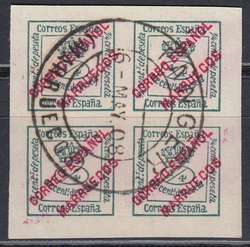


1903, Zeitungsmarke mit schrägem Bdr.-Aufdruck „CORREO ESPANOL / ...mehr
1903, Zeitungsmarke mit schrägem Bdr.-Aufdruck „CORREO ESPANOL / MARRUECOS.



N°18 à 21 en blocs de 4, chaque fois 2 neufs ** et 2 neufs *, TB
N°18 à 21 en blocs de 4, chaque fois 2 neufs ** et 2 neufs *, TB
![Fernauktion]](/de/images/philasearch/ico_mailauction.png "Fernauktion")
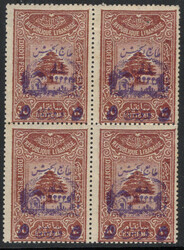
N°197 5 pi sur 30c brun en bloc de 4, neufs **, TB
N°197 5 pi sur 30c brun en bloc de 4, neufs **, TB
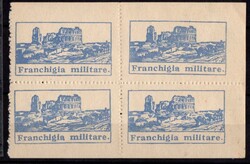
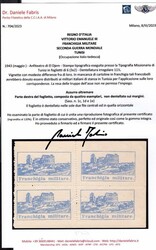
Franchigia Militare - 1943 Tunisi occupazione Italo Tedesca ...mehr
Franchigia Militare - 1943 Tunisi occupazione Italo Tedesca Franchigia militare quartina gomma integra dei valori 1c ;1d;1e Ottimo stato
![Auktion]](/de/images/philasearch/ico_people.png "Auktion")
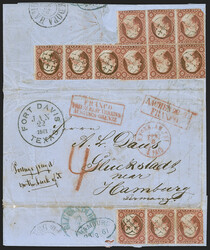

3c Dull Red, Ty. III (26). Block of six and two strips of three — ...mehr
3c Dull Red, Ty. III (26). Block of six and two strips of three — affixed on back with sender's notation "Postage payd on the back of it" — each of the 12 stamps cancelled by clear strike of unusual Four Crossed Arrows and Dots in Circle fancy cancel, perfect bold strike of "Fort Davis Texas Jan. 22, 1861" circular datestamp on blue folded letter to Glückstadt, Denmark, "near Hamburg, Germany," carried by stage to Indianola Tex. on Matagorda Bay, then by steamer to New Orleans and on to New York, red "N. York Am. Pkt. 7 Paid Feb. 9" 7c credit datestamp — the foreign-mail office applied the 7c credit instead of 12c, so this was marked as paid to Prussia only and not to its final destination — carried on the Inman Etna, departing New York Feb. 9, 1861, and arriving Queenstown Feb. 19 and Liverpool Feb. 20 — red "AACHEN 22 2 FRANCO" (Feb. 22) framed datestamp and red "Franco/Preuss.Resp. Vereins/Ausgangs-Grenze" framed handstamp (paid only to limits of German-Austrian Postal Union), "HAMBURG 23/2 61" (Feb. 23) oval and "KDOPA HAMBURG 23/2" (Feb. 23) Royal Danish Postal Agency in Hamburg double-circle datestamp on back, blue Glückstadt receiving backstamp (Feb. 23), red crayon "4" Danish skillings due, approximately six stamps have faults including a few defective, folded letter repaired with blue paper patches on back panelsFINE OVERALL APPEARANCE. A SPECTACULAR COVER FROM FORT DAVIS, TEXAS, TO GLÜCKSTADT IN SCHLESWIG-HOLSTEIN, THEN UNDER DANISH CROWN RULE. THE 35-CENT PRUSSIAN CLOSED MAIL RATE IS PAID WITH 3-CENT 1857 STAMPS CANCELLED BY THE DISTINCTIVE FANCY CANCEL USED AT THE FORT DAVIS POST OFFICE ON THE EVE OF SECESSION. A TRULY REMARKABLE POSTAL HISTORY ARTIFACT FROM SEVERAL PERSPECTIVES.The cover is addressed to Frau A. L. Daus at Glückstadt in Schleswig-Holstein, then under Danish crown rule, with sender's directive "near Hamburg, Germany." The 35c Prussian Closed Mail rate was paid with twelve 3c 1857 Issue stamps affixed on back, which was duly noted by the sender on the address side ("Postage payd on the back of it"). This was transported by the eastbound stage on the San Antonio-San Diego overland mail route from Fort Davis to San Antonio, then on to Indianola. From there it was carried by a contract steamer to New Orleans and on to New York. At the New York foreign-mail exchange office, it was marked and bagged for the Prussian Closed Mail route and sent on the Etna on its first sailing as an Inman line vessel following service on the Cunard line. The Etna departed New York on February 9, 1861, and arrived at the port of Queenstown on February 19 and Liverpool on February 20. The letter entered the German mail system at Aachen on February 22, and on the following day it was transferred to the Danish postal system in Hamburg, then delivered to nearby Glückstadt.Fort Davis was established on October 23, 1854, under the authority of General Persifor F. Smith of the Department of Texas. General Smith selected the site and named it in honor of Jefferson Davis, the Secretary of War. The fort was under the command of Lieutenant Colonel Washington Seawell and manned by companies of the 8th U. S. Infantry from 1854 until April 1861. Fort Davis was the site of the U.S. military's "Camel Corps," championed by Jefferson Davis, which employed camels imported from the Middle East to provide transportation in the southwestern desert.At the time this letter was mailed, Texas was still a part of the United States. The secession convention convened on January 28, 1861, and passed the Ordinance of Secession on February 1, 1861. The requisite popular referendum was held on February 23 and the ordinance was passed, effective March 2, 1861. On the same date, the Provisional Congress of the Confederate States admitted Texas into the CSA, and on March 5 the Texas Convention accepted the invitation to join.The U.S. postmaster of Fort Davis from 1855 to 1861 was Lieut. Thomas Gamble Pitcher. In 1861 he resigned and was replaced by Patrick Murphy, the fort sutler, or another Murphy named Daniel (there are two conflicting reports). Col. John R. Baylor's Confederate cavalry brigade reached Fort Davis on April 13, 1861, and U.S. troops withdrew in compliance with orders already received from Brig. Gen. David E. Twiggs. The Fort Davis postmark on this cover is found on covers dated in both the U.S. and Confederate periods. The fort functioned as a supply depot for General Henry H. Sibley's New Mexico Campaign. In August 1862, U.S. forces regained control of Fort Davis, but did not occupy it. The fort remained abandoned from September 1862 until June 1867, when it was reestablished in a different location.Ex King
Briefmarken Sommer
Los 0906222602
Mi
4
Festpreis
0.50 EUR
Le Timbre Classique Paris
Los 23175
Yv
18/21
250.00 EUR
05.05.2026 10:00 CEST
Le Timbre Classique Paris
Los 23187
Yv
197
700.00 EUR
05.05.2026 10:00 CEST
Asta Neapolis
Los 117
300.00 EUR
10.05.2026 23:59 CEST
Robert A. Siegel Auction Galleries
Los 2122
SC
26
10500.00 USD
(ca. 8947 EUR)
Verkauft
(ca. 8947 EUR)
Aktuelle Zeit: 04.05.2026 - 19:29 Uhr MET