




Catégories

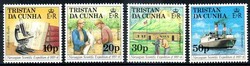

Norwegische wissenschaftliche Expedition 1987, tadellos ...mehr
Norwegische wissenschaftliche Expedition 1987, tadellos postfrisch,
Luxus. M€ 11,--
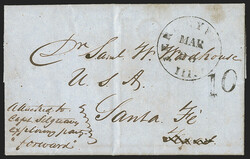

"Attached to Capt. Sitgreaves exploring party - ...mehr
"Attached to Capt. Sitgreaves exploring party - 'forward'".
Manuscript directive on blue 1851 folded letter to "Dr. Saml. W.
Woodhouse, U.S.A., Santa Fe, Texas", with "Texas" crossed out,
"Jerseyville, Ill. Mar. 26" circular datestamp and matching "10"
rate handstamp, part of letter reads "I hope you have a pleasant
company and all goes as pleasantly as possible. I really had
forgotten the time a letter from here would take to reach El Paso
or Santa Fe, to one of which I must direct this and not to San
Antonio as first intended.", carried by Waldo Hall & Co. contract
stagecoach that left Independence Mo. on April 1 and arrived in
Santa Fe on April 30VERY FINE. AN EXTREMELY RARE LETTER TO A MEMBER
OF THE SITGREAVES EXPEDITION IN 1851—CARRIED BY OVERLAND STAGE TO
SANTA FE.Most of the following information about the 1851
Sitgreaves Expedition is quoted from
https://www.southwestexplorations.com/sitgreaves-1851:After the
conquest of New Mexico and California it was apparent that
transportation and communications needed to be improved between
these new territories and the rest of the United States east of the
Mississippi. Geographical knowledge of most of this area,
particularly northwestern New Mexico (now northern Arizona), was
very limited and inaccurate. Some maps of the day showed a river
system that might provide a possible navigable water corridor
between New Mexico and the Gulf of California via the Zuni, Little
Colorado, and Colorado Rivers. An expedition was organized to
investigate the potential shortcut to California.In September of
1851 Captain Lorenzo Sitgreaves, along with a small crew of
topographers, naturalists, artists, and support personnel, and an
escort of 30 infantrymen left the Zuni Pueblo in western New Mexico
by pack train with instructions to explore and map the Zuni and
Colorado Rivers and evaluate their navigability.They traveled
southwest along the Zuni River to its mouth and then headed
northwest along the Little Colorado, intending to follow it to the
Colorado. When they reached Grand Falls (northwest of present-day
Winslow, Arizona) their guide, Antoine Leroux, advised them that it
was unwise to follow the river any further because it flowed in a
deep canyon for the rest of its course and emptied into the great
canyon of the Colorado River.They left the river and struck off due
west around the north side of the San Francisco Mountains,
discovering the Wupatki Indian Ruins along the way, and looped
southwestward around the south side of Bill Williams Mountain. The
rest of their westward march followed near the future alignment of
Route 66 to the Colorado River near the modern town of Bullhead
City, Arizona. After a difficult march south along the Colorado
River they reached Camp Yuma on November 30. Of course, Sitgreaves
discovered that the Zuni and Little Colorado Rivers were not at all
navigable and would be useless to transport troops and supplies.
The Colorado River, however, was found to be navigable along the
entire distance that he explored. Sitgreaves’ official report,
"Report of an Expedition Down the Zuni and Colorado Rivers in
1851," was published in 1853.Included in the expedition was Dr.
Samuel W. Woodhouse, a 30-year-old physician and naturalist.
Although Sitgreaves's report of the expedition is only 18 pages,
Woodhouse kept detailed diaries of the explorations from San
Antonio to San Diego, including notes on the topography, plants,
animals and indigenous population encountered.Ex Vogel and Walske
![Vente aux enchères]](/fr/images/philasearch/ico_people.png "Vente aux enchères")
Veuskens Shop
Lot 0001402522
Mi
429/432
Prix fixe
3.85 EUR
Robert A. Siegel Auction Galleries
Lot 2129
4500.00 USD
(app. 3899 EUR)
Sold
(app. 3899 EUR)
Heure actuelle: 04.04.2026 - 09:40 MET