




 (5)
(5)
Catégories

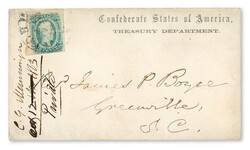
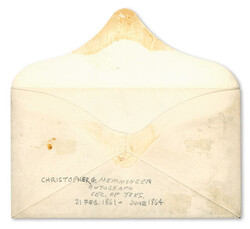
1863 (Oct. 12) Confederate States of America, Treasury
Department ...mehr 1863 (Oct. 12) Confederate States of America, Treasury Department Semi-Official Imprint (C.S.A. Catalog TD-02), franked with #12 tied by "Richmond VA Oct. 13" circular datestamp with "Oct." inverted, addressed to "Rev. James P. Boyce, Greenville S.C." and docketed by Boyce as being sent by "C.G. Memminger Oct. 12, 1863", cover with "De La Rue & Co. London" embossed at top of left backflap, Extremely Fine, this is a very nice cover between two important South Carolinians during the war.
C.S.A. Catalog $350.
The James Petigru Boyce (1827-1888) correspondence is known and he docketed many of his covers at the left regarding the sender. Boyce was a chaplain for a Confederate regiment of volunteers from Greenville, a Representative to the S.C. Legislature, and aide-de-camp to the governor of South Carolina. Boyce was founder and first president of the Southern Baptist Theological Seminary. Christoph Gustavus Memminger (1803-1888) was born in Germany. He was a month old when his father died, and his mother immigrated to South Carolina. Sadly, she died of yellow fever when he was 4, and he was placed in the Charleston Orphan House, where, at the age of 11, was adopted by future governor Thomas Bennett. When South Carolina seceded, Memminger wrote the South Carolina Declaration of Secession, was selected as a South Carolina delegate to the Confederate States Provisional Congress, and chaired the committee which drafted the Provisional Constitution of the Confederate States. When Jefferson Davis formed his first cabinet, Memminger was appointed Secretary of the Treasury on February 21, 1861. It was a difficult task in view of the Confederacy's financial challenges. He attempted to finance the government initially by bonds and tariffs, and the confiscation of gold from the United States Mint in New Orleans. Still, he soon found himself forced to extreme measures such as income taxes and fiat currency. With inflation spiraling out of control, he resigned in June 1864. He appears on the Confederate $5 bill.
![Vente aux enchères]](/fr/images/philasearch/ico_people.png "Vente aux enchères")
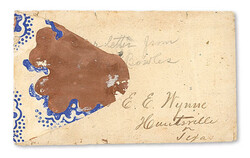
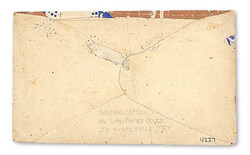
c.1864, Brown and blue on white wallpaper cover, hand
carried to ...mehr c.1864, Brown and blue on white wallpaper cover, hand carried to Huntsville Tex. from soldier in Co. K, "Browns Regt. T.M.V." (Texas Mounted Volunteers), with "War letter from Bro Bowles", edge faults, Fine, a wallpaper cover from a soldier is very rare, especially a Texas soldier.
The regiment was organized in October 1863.
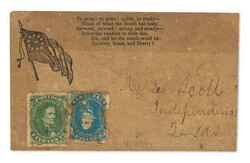
c.1862, 11-Star Flag and Verse Patriotic cover (C.S.A. ...mehr
c.1862, 11-Star Flag and Verse Patriotic cover (C.S.A. Catalog
F11-16, Verse 45), and tassels with "To arms, to arms, quick,
be ready" verse (F11-16, Verse 45) with 5¢ green (1) & 5¢ blue (4),
former 3 large margins and into at right, latter faulty, addressed
to Independence Texas, slightly reduced at right, Fine appearing
combination of the two Jefferson Davis lithograph issues
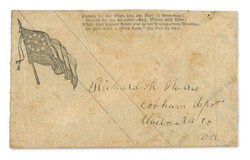
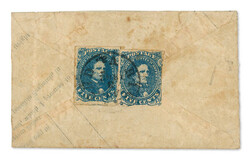
1862 (Aug. 3), 11-Star Flag and Verse Patriotic Adversity ...mehr
1862 (Aug. 3), 11-Star Flag and Verse Patriotic Adversity cover
(C.S.A. Catalog F11-16, Verse 17), and tassles with "Hurrah for
the Stars and the Bars of Secsssion!" verse, franked with #4 stone
2 (left stamp; full to large margins all around with trace of
adjacent stamp at bottom) and #4 stone 3 (right; three ample
margins to just into at right) canceled by "Richmond VA Aug. 3,
1862" circular datestamp on reverse, addressed to Cobham (Railroad)
Depot, with the cover made from a portion of a blank commercial
shipping form (possibly railroad), exploded for display, Fine to
Very Fine. This is the first time we have seen a Confederate
patriotic adversity cover with the added bonus of being addressed
to a railroad depot
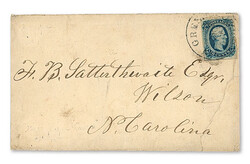
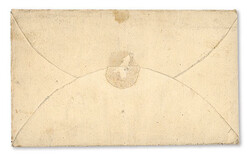
c.1863 (Oct. 5), white on cream textured wallpaper cover,
franked ...mehr c.1863 (Oct. 5), white on cream textured wallpaper cover, franked with #12d with four margins and tied by "Greensborough Ala. Oct. 5" circular datestamp, addressed on white wallpaper cover to "F.B. Satterthwaite, Esq., Wilson N. Carolina,", bottom flap folded over to front for display, left flap reattached, still Very Fine, see the wallpaper interior online.
The recipient, Fenner Bryan Satterthwaite (1813-1875), studied law while in debtor's prison and later rose to immense legal and political success. He was elected to the House of Representatives from Beaufort Co. in 1836 and from Pitt Co. in 1848. He was one of the defense lawyers at the murder trial of the Rev. George W. Carawan of Hyde County, who was convicted of murder in November 1853, then immediately shot the prosecuting attorney who survived because the bullet hit a locket near his heart, then killed himself. Read about this on murderpedia.org. Yes, murderpedia.org; it is real.
Kelleher Auctions
Lot 2045
Department ...mehr 1863 (Oct. 12) Confederate States of America, Treasury Department Semi-Official Imprint (C.S.A. Catalog TD-02), franked with #12 tied by "Richmond VA Oct. 13" circular datestamp with "Oct." inverted, addressed to "Rev. James P. Boyce, Greenville S.C." and docketed by Boyce as being sent by "C.G. Memminger Oct. 12, 1863", cover with "De La Rue & Co. London" embossed at top of left backflap, Extremely Fine, this is a very nice cover between two important South Carolinians during the war.
C.S.A. Catalog $350.
The James Petigru Boyce (1827-1888) correspondence is known and he docketed many of his covers at the left regarding the sender. Boyce was a chaplain for a Confederate regiment of volunteers from Greenville, a Representative to the S.C. Legislature, and aide-de-camp to the governor of South Carolina. Boyce was founder and first president of the Southern Baptist Theological Seminary. Christoph Gustavus Memminger (1803-1888) was born in Germany. He was a month old when his father died, and his mother immigrated to South Carolina. Sadly, she died of yellow fever when he was 4, and he was placed in the Charleston Orphan House, where, at the age of 11, was adopted by future governor Thomas Bennett. When South Carolina seceded, Memminger wrote the South Carolina Declaration of Secession, was selected as a South Carolina delegate to the Confederate States Provisional Congress, and chaired the committee which drafted the Provisional Constitution of the Confederate States. When Jefferson Davis formed his first cabinet, Memminger was appointed Secretary of the Treasury on February 21, 1861. It was a difficult task in view of the Confederacy's financial challenges. He attempted to finance the government initially by bonds and tariffs, and the confiscation of gold from the United States Mint in New Orleans. Still, he soon found himself forced to extreme measures such as income taxes and fiat currency. With inflation spiraling out of control, he resigned in June 1864. He appears on the Confederate $5 bill.
360.00 USD
(app. 306 EUR)
Sold
(app. 306 EUR)
Kelleher Auctions
Lot 2049
carried to ...mehr c.1864, Brown and blue on white wallpaper cover, hand carried to Huntsville Tex. from soldier in Co. K, "Browns Regt. T.M.V." (Texas Mounted Volunteers), with "War letter from Bro Bowles", edge faults, Fine, a wallpaper cover from a soldier is very rare, especially a Texas soldier.
The regiment was organized in October 1863.
240.00 USD
(app. 204 EUR)
Sold
(app. 204 EUR)
Kelleher Auctions
Lot 2046
360.00 USD
(app. 306 EUR)
Sold
(app. 306 EUR)
Kelleher Auctions
Lot 2047
1 images supplémentaires
360.00 USD
(app. 306 EUR)
Sold
(app. 306 EUR)
Kelleher Auctions
Lot 2048
franked ...mehr c.1863 (Oct. 5), white on cream textured wallpaper cover, franked with #12d with four margins and tied by "Greensborough Ala. Oct. 5" circular datestamp, addressed on white wallpaper cover to "F.B. Satterthwaite, Esq., Wilson N. Carolina,", bottom flap folded over to front for display, left flap reattached, still Very Fine, see the wallpaper interior online.
The recipient, Fenner Bryan Satterthwaite (1813-1875), studied law while in debtor's prison and later rose to immense legal and political success. He was elected to the House of Representatives from Beaufort Co. in 1836 and from Pitt Co. in 1848. He was one of the defense lawyers at the murder trial of the Rev. George W. Carawan of Hyde County, who was convicted of murder in November 1853, then immediately shot the prosecuting attorney who survived because the bullet hit a locket near his heart, then killed himself. Read about this on murderpedia.org. Yes, murderpedia.org; it is real.
228.00 USD
(app. 194 EUR)
Sold
(app. 194 EUR)
Heure actuelle: 21.02.2026 - 11:13 MET